
Karnataka is a world on its own. And Badami is a good representative of the rich diversity of its cultural heritage.
Karnataka has been called the laboratory of Hindu temple architecture. And Badami is one of its greatest centers where the origin and evolution of temple architecture can be traced. Located in Bagalkot district of northern Karnataka, in the famed Deccan it is a great Hindu cultural center. Badami, along with Pattadakallu, Aihole and Mahakoota creates an ensemble which displays a wide variety of temples. The seat of the great Badami Chalukyas, Badami has one of the earliest cave temples of India, in which Hindu iconography touches some of its greatest heights. But it does not stop at cave temples and the evolution can be seen in the later temples around the lake.
Hindu temple architecture in its classical form reaches its zenith in Pattadakallu, where on one platform lie many different kinds of architectural styles and where Nagara and Dravida temples stand on one platform and the beginnings of the Vesara style can be seen. Aihole on the other hand displays the various stages of temple architecture evolution at one site. Mahakoota shows how ancient temples remain living and Banashankari temple shows how shakti pooja in this great land touches all walks of life.
Bodha Anveshi Badami chapter offers a deep study of Hindu temple architecture, sculpture and iconography in its various dimensions. It also aims to explore the dynamic of the living temple eco-systems which remain so vibrant in this part of Bharatavarsha.
Arrive at Badami and stay the night.
Naganatha Temple Complex, Naganatha
Mahakoota Temple Complex
Pattadakallu Temple Complex
– Galganatha Temple
– Kadhasiddheshvara Temple
– Jambulingeshvara Temple
– Sangameshvara Temple
– Kashi Vishvanatha Temple
– Mallikarjuna Temple
– Virupaksha Temple
– Papanatha Temple
Shri Shakambhari Shakti Peetham, Banashankari
We take our flights and go home.

A scholar of Hindu temple architecture, Hindu arts and aesthetics. Having visited more than 1600 ancient temples all over Bhārata, he has documented photographic, historical, and oral evidence of the living traditions centered around the Hindu temple. He writes on the meaning and purpose of the Hindu temple in Hindu society and history, and has authored various articles on that topic.
Badami Cave Temples are one of the earliest Hindu caves, dating to around the 6th century. It has mainly four elaborate cave temples, three Hindu, and one Jain. The Hindu caves sport some of the finest sculpture ever to be found in the history of Hindu sculpture. From the great Nataraja in his most spectacular form, to Shri Vishnu sitting on a Shesha, saving Bhudevi in his Varaha form, extending his third leg in his Trivikrama form, Shri Vishnu in Harihara form, Shri Vishnu in Narasimha form, Vishnu in standing form with Bhudevi and Sridevi etc. it presents the visitor with a vista rarely seen together at one place. Along with that there are absolutely wonderful sculptures of flying celestials like vidyadharas, load bearers depicted on capitals of columns, the bharavahakas and many amorous couples which gives the place a different character. The glowing pink and red sandstone just brings out the beauty of the place even more. Being hidden under limestone owing to its cave structures, the temples were never desecrated and thus present to us some of the finest unsullied, never desecrated examples of Hindu temple architecture.
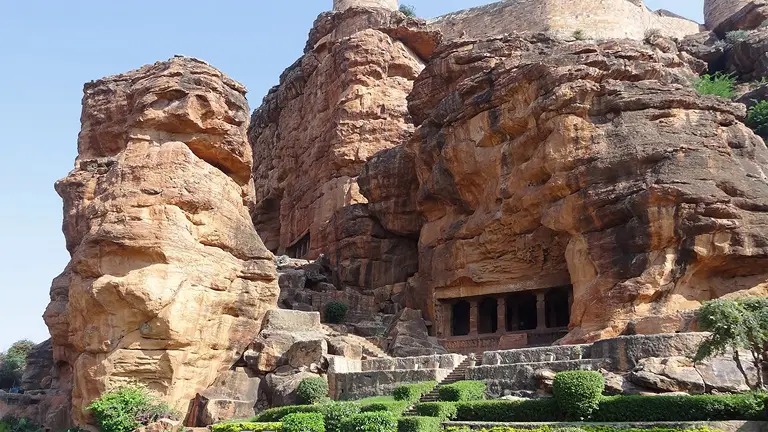
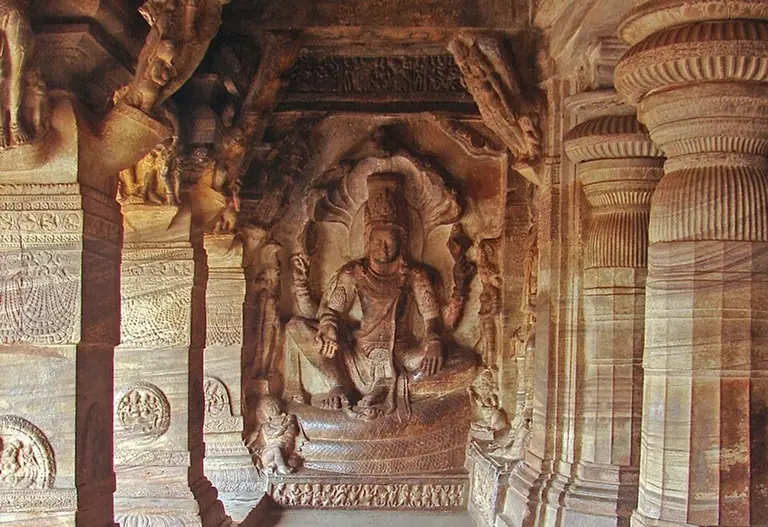
Badami Cave Temples are one of the earliest Hindu caves, dating to around the 6th century. It has mainly four elaborate cave temples, three Hindu, and one Jain. The Hindu caves sport some of the finest sculpture ever to be found in the history of Hindu sculpture. From the great Nataraja in his most spectacular form, to Shri Vishnu sitting on a Shesha, saving Bhudevi in his Varaha form, extending his third leg in his Trivikrama form, Shri Vishnu in Harihara form, Shri Vishnu in Narasimha form, Vishnu in standing form with Bhudevi and Sridevi etc. it presents the visitor with a vista rarely seen together at one place. Along with that there are absolutely wonderful sculptures of flying celestials like vidyadharas, load bearers depicted on capitals of columns, the bharavahakas and many amorous couples which gives the place a different character. The glowing pink and red sandstone just brings out the beauty of the place even more. Being hidden under limestone owing to its cave structures, the temples were never desecrated and thus present to us some of the finest unsullied, never desecrated examples of Hindu temple architecture.
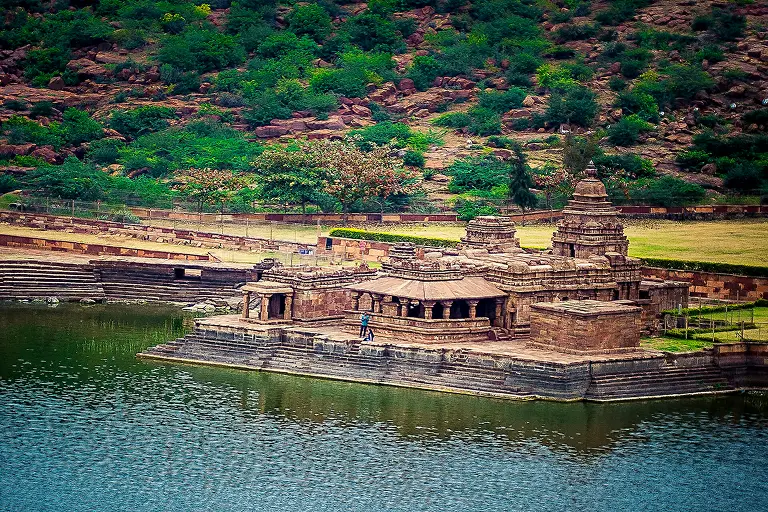
Arranged at the far end of the lake, the Bhutanatha group of temples were created by the Badami Chalukyas in the next stage of temple evolution, the same dynasty which carved the cave temples nearby. Created in the beginning of the 8th century this group represents typical Dravida architecture of those times. This group has one main temple with a Dravida tritala shikhara and a closed mandapa with a sloping roof. The mandapa is remarkable with four central pillars bearing the load, while the garbha-griha is dedicated to Lord Shiva. The other structures have deteriorated with time. The other group of temples are called the Mallikarjuna group of temples a little further away on the opposite side of the cave temples. Though they look similar but these temples were built two centuries after the Bhutanatha group, and was made by another completely different dynasty called the Kalyani Chalukya dynasty in 11th and 12th centuries. It contains five main temples having a phamsana nagara shikhara. The main temple has an open and a closed mandapa. Earlier dedicated to Shri Vishnu now it is a Shiva temple. These temples display Hindu temple architecture in evolution.
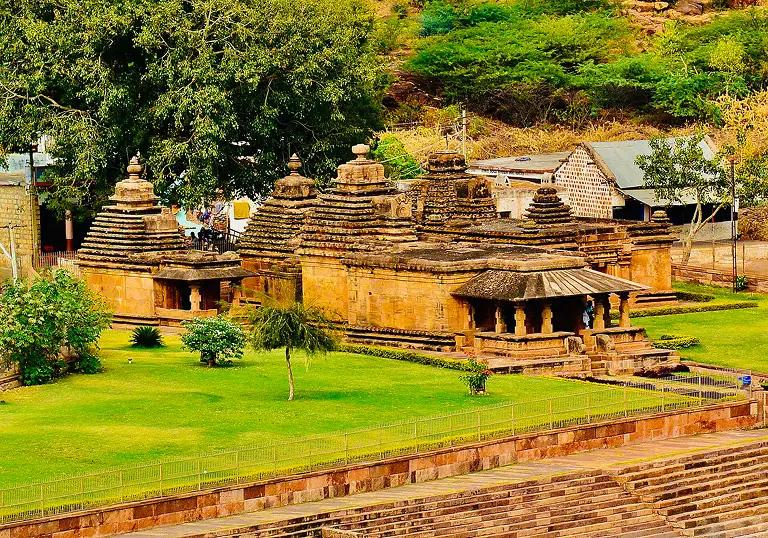
The Mallikarjuna group of temples a little further away from the Badami cave temples, on the opposite side of the cave temples. Though they look similar but these temples were built two centuries after the Bhutanatha group, and was made by another completely different dynasty called the Kalyani Chalukya dynasty in 11th and 12th centuries. It contains five main temples having a phamsana nagara shikhara. The main temple has an open and a closed mandapa. Earlier dedicated to Shri Vishnu now it is a Shiva temple. These temples display Hindu temple architecture in evolution.
This temple complex has essentially one great temple which is emblematic of the early dravida style as seen in these parts of India. The temple is made in pure dravida style with a pyramidal tier roof rising over the garbhagriha. The mandapa is huge and closed with a sloping roof structure topped with stones in the shape of wooden beams indicating that early Hindu temple architecture in stone was copied from the wooden architecture. The temple also has an open mandapa which can also be called as the nandi mandapa but is in architectural continuation with the rest of the structure. Situated in a grove at a secluded corner of the district this temple is a great marvel of early Chalukyan architecture.
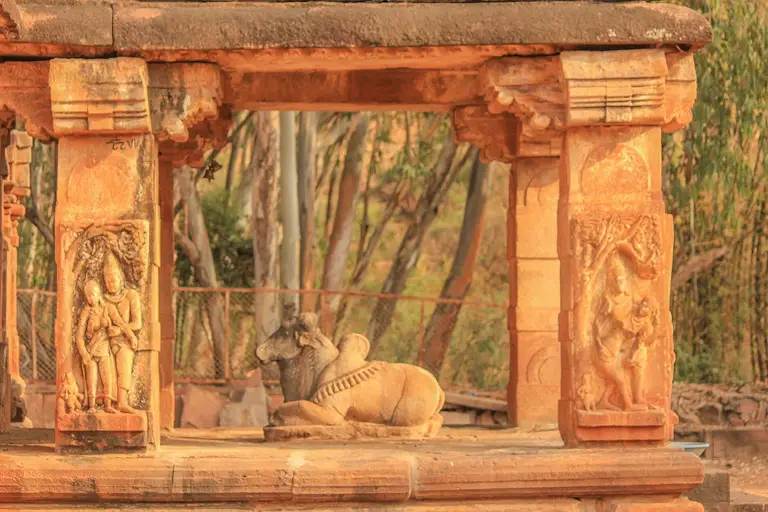
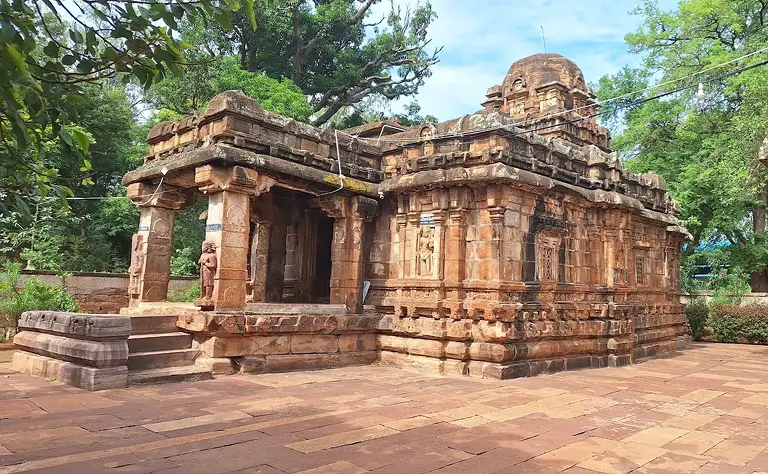
One of the earliest structural temples of India, built towards the end of the sixth and the beginning of the seventh century, this temple complex is dedicated primarily to Lord Shiva. Built by the great Chalukyas this site also sports great early nagara temples along with dravida temples around a sacred pond. With the walls of the temples of two styles virtually indistinguishable and differences arising only in shikharas, this marks the beginning of the mixed (vesara) style of architecture in Karnataka. A natural stream is captured in the temple pond which is called the Papavinashaka Kunda, where it is believed that our sins are washed away. In the center of this pond is a panchmukhi Shivalinga. These temples are remarkable for their early design and beautiful sculpture and the fact that they are still functioning and are living structures.
If one has to choose one cradle of temple architecture in all of India then it is Pattadakallu. Created in the early 7th and 8th centuries, by the great Badami Chalukya dynasty, it represents the next great stage in evolution of Hindu temple architecture. If Badami caves represent the earliest experiments of Hindus in cave temples, then Pattadakallu represents one of the earliest great experiments in structural temples. There are very few other sites in India where on one platform you can see as many temple styles and their evolution through ages as you can in Pattadakallu. Situated on the banks of the Malaprabha river, this used to be the place where the Badami Chalukya kings were consecrated. Galgantha represents a mature style of the same latina nagara style.
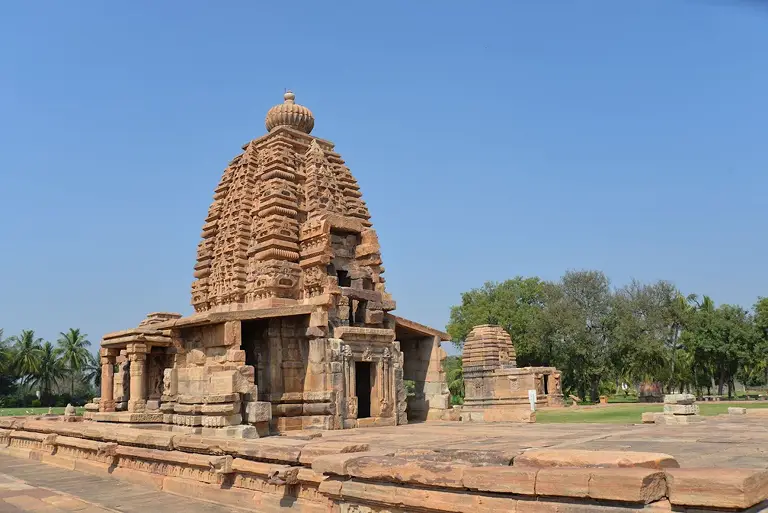
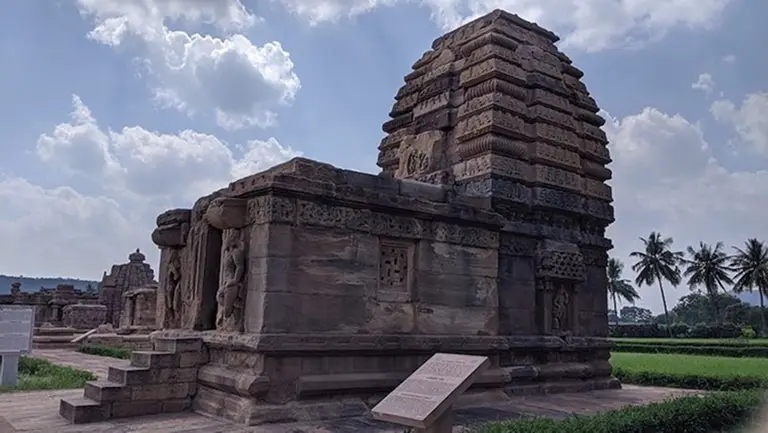
If one has to choose one cradle of temple architecture in all of India then it is Pattadakallu. Created in the early 7th and 8th centuries, by the great Badami Chalukya dynasty, it represents the next great stage in evolution of Hindu temple architecture. If Badami caves represent the earliest experiments of Hindus in cave temples, then Pattadakallu represents one of the earliest great experiments in structural temples. There are very few other sites in India where on one platform you can see as many temple styles and their evolution through ages as you can in Pattadakallu. Situated on the banks of the Malaprabha river, this used to be the place where the Badami Chalukya kings were consecrated. Kasiddheshwara is small but represents the earliest stages of latina nagara style of temples.
If one has to choose one cradle of temple architecture in all of India then it is Pattadakallu. Created in the early 7th and 8th centuries, by the great Badami Chalukya dynasty, it represents the next great stage in evolution of Hindu temple architecture. If Badami caves represent the earliest experiments of Hindus in cave temples, then Pattadakallu represents one of the earliest great experiments in structural temples. There are very few other sites in India where on one platform you can see as many temple styles and their evolution through ages as you can in Pattadakallu. Situated on the banks of the Malaprabha river, this used to be the place where the Badami Chalukya kings were consecrated. Sangameshwara represents the period of early maturity of Dravida style shikhara where most of the elements of the style are in place.
Participants should have innate shraddha (reverence) in the Hindu tradition and be open and willing to experience it. The trust in the Guru Sishya Parampara is of utmost importance to undertake this yatra. Also, as this is an in-person retreat, prepare in advance to be physically present and capable at the venue. Participants should be medically fit to endure physical exertion.
In our culture, there is no age restriction as to when one can embark on an exploration in life.
However, from our experience of such yātrās, we have learnt that the below guidelines have been helpful:
This is not a regular tour programme and our focus is always on the darshan, understanding the history, culture, rituals, lore and traditions of the places we visit. Hence, daily travel can span anywhere between 3-5 hours with brief recesses. It’s also important to remember that the itinerary is subject to changes based on local contexts such as weather, pilgrimage crowds/queues, temple festivals, rituals, schedules etc.
Cost includes:
All the tour related expenses are already covered in the travel cost. However, personal expenses during the trip such local snacks, shopping, souvenirs etc should be kept in mind. Also, participants will bear expenses in case of evacuation due to medical emergencies or natural calamities such as earthquakes etc towards travel, boarding, lodging and medical costs.
Click on the ‘Register Now’ button on the webpage. Proceed to the Google form and fill the required details, upload the documents requested and submit. We will process your submission and verify documentation within 2-3 working days of your submission.
After 3 working days, you can expect a confirmation email (which will be sent to the email id with which you registered) which will have: Payment details and Enrollment Completion Form. Make payment using the payment details and upload the payment screenshot in order to secure your admission into the program. We will send you an acknowledgement email confirming this. After this step, you can proceed to book tickets and plan your travel/logistics to reach meeting point on Day 1. In any of the above steps, if you have questions, please do contact us over email or phone. A WhatsApp group will be formed closer to program dates for planning and coordination.
We will be there to assist you at each stage of the process and you can reach out to us at bikaner@yatrautsav.com for any query. In the meanwhile, you can try to avoid the following mistakes to make the registration process easier: Incomplete and incorrect information: Name, Email id, Phone Number etc. Uploading unclear photo or ID proof or B&W photo. Do remember that filling your name, email address and phone number is just the first step showing your interest in the programme. Be sure to check email for acknowledgement of your payment and receipt of enrollment completion form.
In case you are not able to join the yātrā due to any avoidable or unavoidable reason(s), you should notify us at the earliest in writing at payments@yatrautsav.com.
Our Refund Policy:
Cancellations